
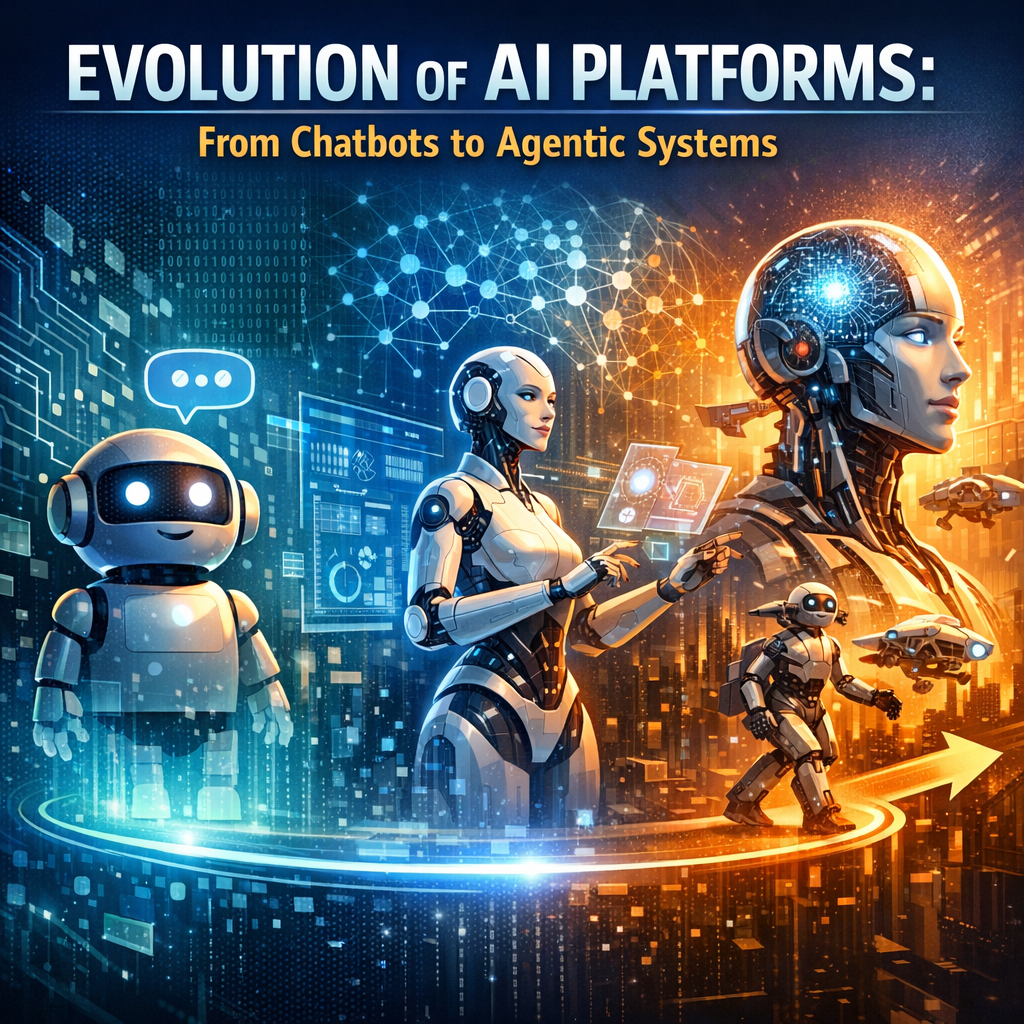
Evolution of AI Platforms: From Chatbots to Agentic Systems
The Evolution of AI Platforms: From Chatbots to Full Agentic Systems
The trajectory of artificial intelligence (AI) has been nothing short of revolutionary. From rudimentary chatbots to the sophisticated, fully agentic systems we see today, AI technology has transcended its initial applications, heralding a new era of digital interaction and automation. This article explores the evolution of AI platforms, highlighting key milestones and the transformative impact of these technologies.
The Birth of AI and Early Chatbots
The journey of AI began in the mid-20th century, but it wasn’t until the 1990s and early 2000s that AI chatbots started to become a reality. These early chatbots were simple programs designed to simulate conversation with human users. The most notable among them was ELIZA, a program developed at MIT in 1966, which could mimic human conversation by matching user input to predetermined scripts.
Advancements in Natural Language Processing
As natural language processing (NLP) technologies improved, so did chatbots. They became more sophisticated in understanding and generating human language, moving beyond simple pattern matching to more complex algorithms that could learn from interactions.
Transition to More Advanced AI
By the 2010s, advancements in machine learning and deep learning opened up new possibilities for AI applications beyond simple text-based chatbots. AI systems began to integrate with various data sources and services, enhancing their capabilities and utility.
Integration with IoT and Big Data
AI platforms started harnessing the power of the Internet of Things (IoT) and big data analytics. This integration allowed AI systems to not only interact through text but also to control devices, analyze large datasets, and make data-driven decisions.
Adaptive Learning Capabilities
Another significant advancement was the development of adaptive learning algorithms. These enabled AI systems to learn from their environments and improve their responses over time, making them more personalized and effective.
The Rise of Full Agentic Systems
The latest phase in the evolution of AI platforms is the emergence of full agentic systems. These systems are not just reactive but are proactive, capable of performing complex tasks and making autonomous decisions based on their programming and learning.
Examples of Full Agentic Systems
- Autonomous Vehicles: AI systems in self-driving cars can navigate roads, recognize obstacles, and make real-time decisions, all without human intervention.
- Smart Assistants: Beyond simple voice commands, AI assistants in smart homes can manage everything from scheduling to energy conservation, learning household habits and preferences along the way.
Capabilities That Set Them Apart
- Decision Making: Full agentic systems can weigh options and make decisions, simulating a level of cognitive ability.
- Problem Solving: These systems can identify problems, devise potential solutions, and execute them autonomously.
- Interaction with Physical World: Unlike their predecessors, these AI systems can manipulate physical environments, performing tasks ranging from precision surgery to assembling complex machinery.
Challenges and Future Directions
Despite the impressive advancements, the path forward for AI is paved with challenges.
Ethical Considerations
As AI systems become more autonomous, ethical concerns, particularly regarding privacy, surveillance, and decision-making, come to the forefront. Ensuring these systems operate within ethical guidelines is paramount.
Technical Challenges
The complexity of creating reliable, safe, and efficient agentic systems is a significant hurdle. Issues such as algorithmic bias, system security, and error mitigation are critical areas needing attention.
Regulation and Control
The development of comprehensive regulations that keep pace with AI advancements is crucial. These regulations will help manage the impact of AI systems on society and ensure they contribute positively without causing unintended harm.
Conclusion
From simple programmed responses in early chatbots to the advanced decision-making capabilities of full agentic systems, AI has evolved dramatically. As AI continues to integrate into every aspect of human life, it promises even more transformative changes. However, navigating this future will require careful consideration of the ethical, technical, and regulatory challenges that come with such powerful technology. The evolution of AI platforms is not just a technological journey but a societal shift, poised to redefine our relationship with machines.