
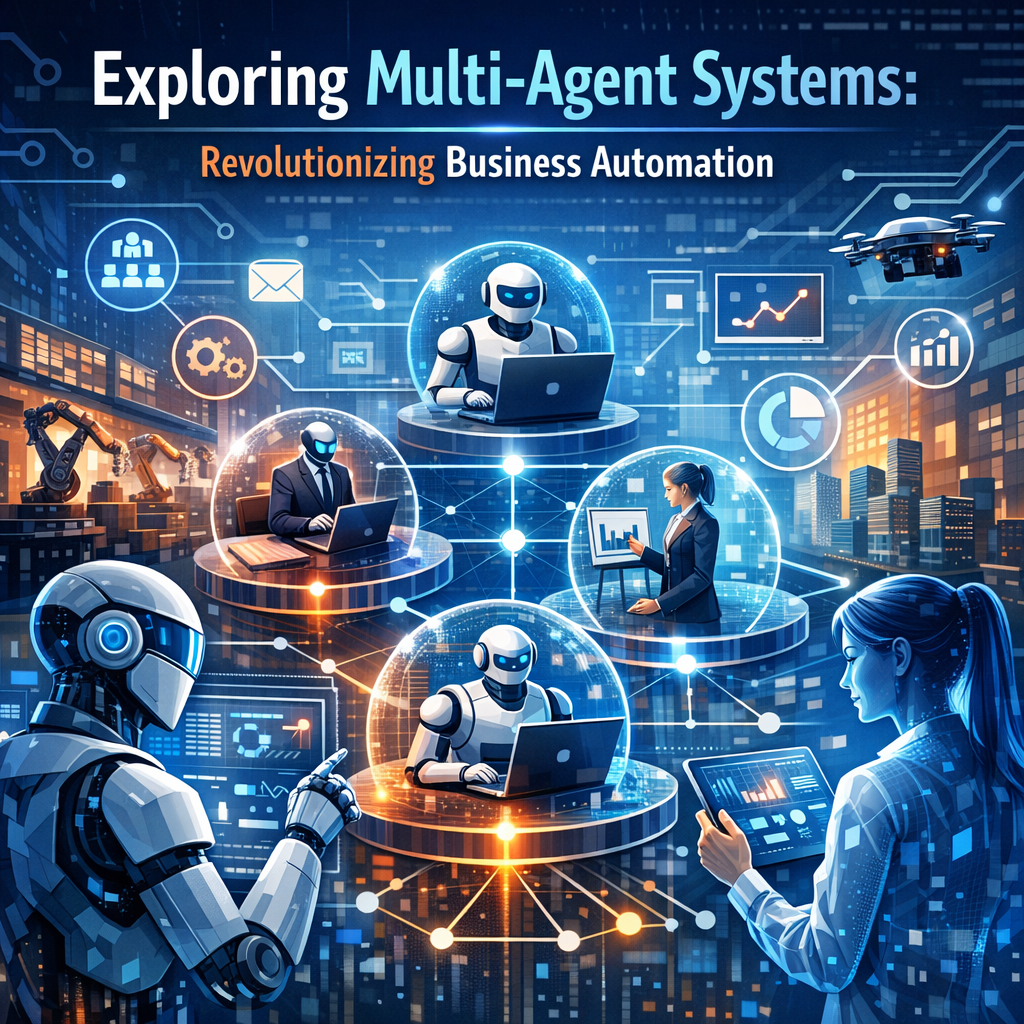
Exploring Multi-Agent Systems: Revolutionizing Business Automation
Multi-Agent Systems: The Next Leap in Business Automation
Business automation has been a game-changer in enhancing efficiency and reducing costs across various industries. As technology progresses, we find ourselves on the cusp of the next major leap in the evolution of automation: Multi-Agent Systems (MAS). This innovative approach is set to revolutionize how businesses operate and interact.
What Are Multi-Agent Systems?
Multi-Agent Systems consist of multiple decision-making agents. These agents can operate autonomously or in collaboration, depending on the objectives set. Each agent in the system has the capability to perceive its environment, and based on that information, it takes actions to achieve specific goals. The true power of MAS lies in their ability to collaborate and learn from one another, leading to optimized decision-making processes.
How Do Multi-Agent Systems Work?
The functionality of Multi-Agent Systems can be broken down into several key components:
Autonomous Agents
Each agent is capable of operating independently, making decisions without human intervention. This autonomy is crucial for scaling operations and improving response times in dynamic environments.
Communication
Agents communicate with one another to share information and insights. This collaboration enables the system to make more informed decisions than any single agent could on its own.
Adaptation
Agents in a MAS can adapt based on outcomes and interactions. This continuous learning process allows the system to improve its performance over time, adapting to new challenges and environments.
Coordination
Coordination among agents is essential for handling complex tasks that require cooperative effort. Through effective coordination, MAS can optimize workflows and resource allocation.
Benefits of Multi-Agent Systems in Business
Integrating Multi-Agent Systems into business operations brings several significant advantages:
- Increased Efficiency: MAS can operate around the clock without fatigue, ensuring consistent productivity levels and faster execution of tasks.
- Scalability: Businesses can scale operations quickly by adding more agents as needed without the typical constraints associated with human workforces.
- Flexibility: Multi-Agent Systems can be adapted for a wide range of applications, from supply chain management to customer service and beyond.
- Enhanced Decision-Making: By leveraging collective intelligence, MAS can analyze large datasets and complex variables to make informed decisions quickly.
Real-World Applications of Multi-Agent Systems
Multi-Agent Systems are already making impressive strides in various sectors. Here are a few examples:
Healthcare
In healthcare, MAS can manage patient care processes, from scheduling to diagnostics and treatment recommendations, enhancing the overall efficiency and patient outcomes.
Manufacturing
In manufacturing, MAS coordinate robots and other machinery to optimize production lines, adjust to changes in demand, and minimize downtime.
Transportation
For transportation, MAS offer solutions in traffic management and logistics, significantly reducing delays and improving supply chain reliability.
Customer Service
In customer service, MAS manage interactions across multiple platforms, providing timely and consistent support to enhance customer satisfaction.
Challenges and Considerations
While the potential of Multi-Agent Systems is immense, there are challenges to consider:
- Complexity in Integration: Implementing MAS within existing systems can be complex and requires significant upfront investment.
- Security Concerns: With multiple agents communicating, there is an increased risk of data breaches unless robust security measures are in place.
- Skill Requirements: Businesses might face a skills gap as MAS require specialist knowledge for development and maintenance.
The Future is Collaborative
Multi-Agent Systems represent a pioneering step forward in business automation, promising not only to enhance operational efficiency but also to enable more intelligent, adaptive, and robust business processes. As businesses increasingly recognize the benefits of MAS, we are likely to see a surge in their adoption across sectors, pushing the boundaries of what automated systems can achieve.
As we look towards a future where business operations are increasingly automated, Multi-Agent Systems stand out as a beacon of transformative potential, deploying collaborative intelligence to tackle the most complex challenges in business today.