
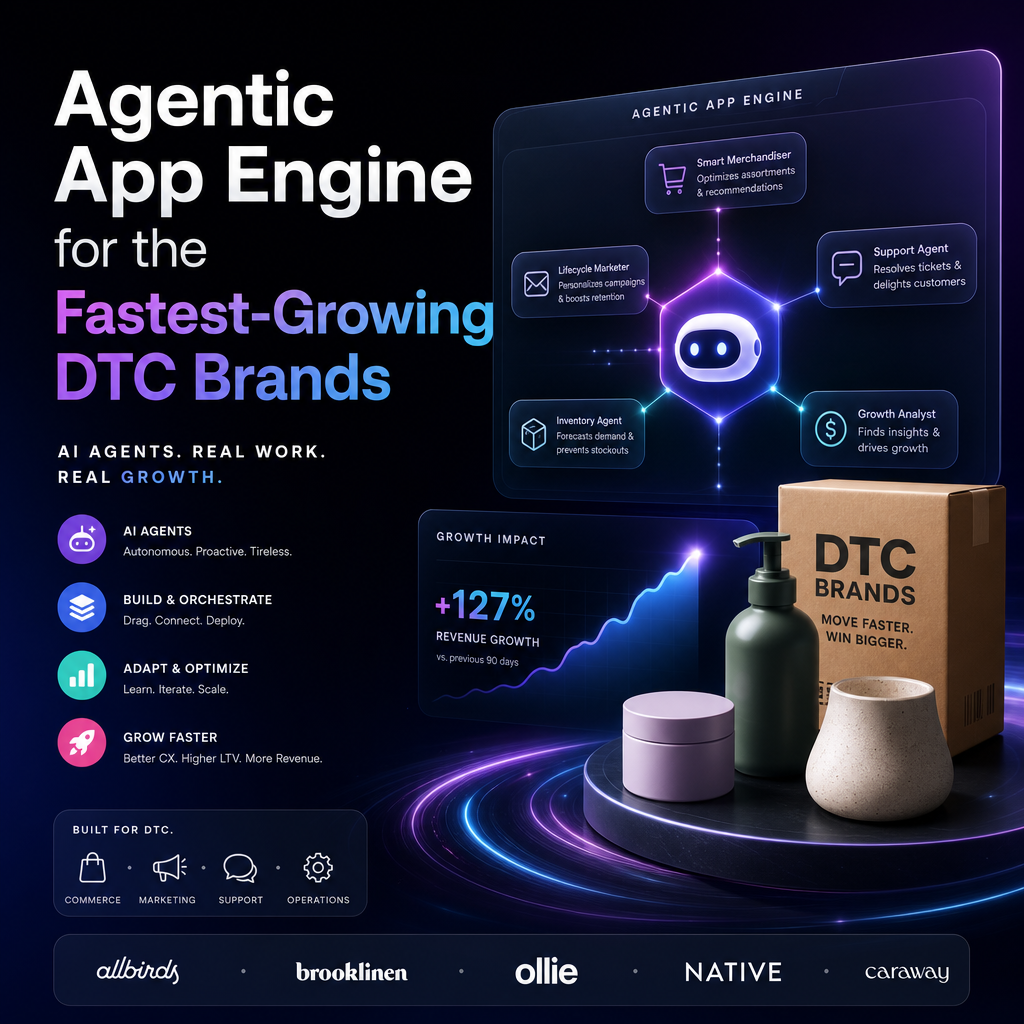
Agentic App Engine for the Fastest-Growing DTC Brands
The Agentic App Engine Behind the Fastest-Growing DTC Brands
The fastest-growing DTC brands are no longer winning with product alone. They are winning with speed, personalization, and the ability to act on customer signals in real time. That is where the agentic app engine comes in.
An agentic app engine is more than a dashboard, workflow builder, or AI add-on. It is a system that can observe what is happening across the business, make decisions based on goals, and trigger the right actions automatically. For DTC operators, that means less manual coordination and more momentum across acquisition, retention, support, and operations.
Why DTC Brands Need More Than Automation
Traditional automation is useful, but limited. It follows fixed rules:
- If a customer abandons cart, send email
- If inventory drops, alert the team
- If a ticket is opened, assign it to support
Those flows help, but they do not adapt well when conditions change.
A fast-moving DTC brand needs something smarter. Customer behavior shifts daily. Ad costs rise and fall. Inventory moves unpredictably. Support issues spike after launches. In that environment, static workflows often create more work instead of less.
The agentic app engine solves a different problem. It does not just execute instructions. It interprets context, prioritizes actions, and coordinates systems around outcomes.
What an Agentic App Engine Actually Does
At its core, an agentic app engine connects data, goals, and action.
It pulls signals from the tools DTC brands already use, such as:
- Shopify
- Klaviyo
- Meta Ads
- Google Analytics
- Gorgias
- Recharge
- NetSuite or ERPs
- Loyalty and subscription platforms
Then it uses that information to decide what should happen next.
Example: From Data to Action
Imagine a brand launches a new product.
A traditional stack might show the team:
- traffic is up
- conversion is down
- support tickets are rising
- a key size is nearly out of stock
An agentic app engine goes further. It can:
- detect that conversion is dropping due to size confusion
- surface support conversations tied to fit questions
- update onsite messaging
- trigger segmented retention flows for customers likely to churn
- pause ads for the low-stock variant
- notify operations to rebalance inventory planning
Instead of waiting for five teams to review five tools, the system helps the brand respond immediately.
The Real Advantage: Operational Leverage
The biggest benefit is not just efficiency. It is leverage.
Fast-growing DTC brands often hit a ceiling when growth creates complexity. More channels, more SKUs, more customer journeys, and more edge cases usually mean more people, more tools, and more delays.
The agentic app engine reduces that drag by acting like an operating layer across the business.
It helps teams:
Move faster
Decisions that once took hours or days can happen in minutes.
Personalize at scale
Customers can receive tailored experiences based on behavior, lifecycle stage, and predicted intent.
Reduce tool sprawl
Instead of adding another point solution, brands can coordinate the stack they already have.
Focus on strategy
Operators spend less time managing workflows and more time shaping growth.
Where It Shows Up in the Customer Journey
The best DTC brands are using agentic systems across the full funnel.
Acquisition
The engine can monitor campaign performance, creative fatigue, landing page conversion, and customer quality. It can shift budget recommendations, trigger new tests, or alert teams before waste compounds.
Conversion
Onsite, it can adapt messaging based on traffic source, returning visitor behavior, or inventory pressure. A customer arriving from a paid social ad may see a different experience than a repeat subscriber.
Retention
Retention is where an agentic app engine often creates outsized value. It can identify churn risk, spot changes in purchase cadence, and launch win-back actions before revenue is lost.
Support and CX
Rather than treating support as a reactive function, the engine can detect issue patterns, route conversations intelligently, and flag operational problems behind customer complaints.
Why This Matters Now
DTC is more competitive than ever. Paid media is expensive. Customers expect relevance. Margins are tighter. And brands cannot afford slow decision-making across disconnected systems.
The old model was simple: add another app, another analyst, another manager.
That model does not scale well.
The next generation of growth comes from systems that can reason across the business and act with clear goals. That is why the idea of the agentic app engine is getting so much attention. It brings together AI, workflow orchestration, and operational intelligence in a way that fits how modern commerce actually works.
What to Look for in an Agentic App Engine
Not every AI tool qualifies. DTC leaders should look for a platform that can:
- connect to core commerce and marketing systems
- understand business context, not just raw events
- trigger actions across channels
- support human approval where needed
- learn from outcomes over time
- stay transparent about why decisions were made
Trust matters. If a system is going to influence customer experience and revenue, teams need visibility and control.
Final Thoughts
The fastest-growing DTC brands are building a new kind of stack. One that does not just collect data or automate tasks, but actively helps the business move.
That is the promise of the agentic app engine.
It gives lean teams the ability to operate with more precision, react with more speed, and scale without drowning in manual complexity. In a market where execution is often the difference between momentum and stagnation, that edge matters.
For DTC brands chasing the next stage of growth, the question is no longer whether AI will be part of the operating model. It is what kind of engine will sit at the center of it.