
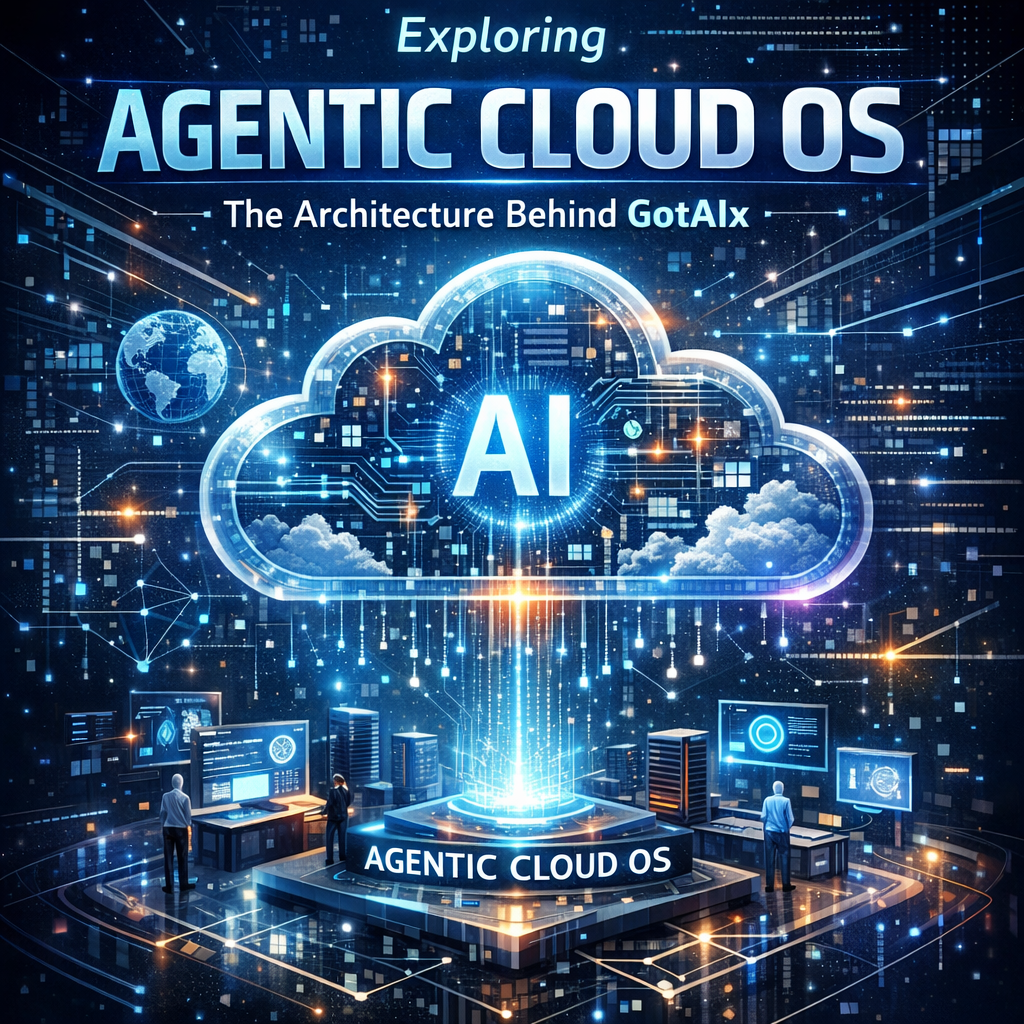
Exploring Agentic Cloud OS: The Architecture Behind GotAIx
What Is an Agentic Cloud OS? The Architecture Behind GotAIx
In the rapidly evolving world of technology, new terms and innovations appear almost daily. One such innovation, sparking interest across sectors, is the Agentic Cloud OS, powered by the intriguing architecture of GotAIx. Here, we delve into what an Agentic Cloud OS is, the core architecture of GotAIx, and why this technology might be a game-changer in cloud computing.
Understanding the Agentic Cloud OS
An Agentic Cloud Operating System (OS) is an advanced form of cloud infrastructure that leverages AI to manage and control various cloud resources autonomously. Unlike traditional cloud systems that require significant human intervention for management tasks, an Agentic Cloud OS automates these processes, making cloud environments more adaptive, efficient, and scalable.
Key Features of an Agentic Cloud OS:
- Autonomous Resource Management: Automatically handles resource allocation, optimization, and scaling without human input.
- Intelligent Decision Making: Employs sophisticated AI algorithms to make real-time decisions based on system-wide data.
- Enhanced Security Protocols: Uses AI-driven security measures to predict, detect, and mitigate potential threats instantaneously.
The Architecture Behind GotAIx
GotAIx is at the forefront of implementing the Agentic Cloud OS. Its architecture is designed to not only support but enhance the capacities of cloud computing platforms through intelligent automation and predictive analytics.
Core Components of GotAIx:
- Data Integration Layer: This foundational layer aggregates data from various sources to be utilized for real-time processing and decision-making.
- AI Engines: Multiple AI algorithms work simultaneously to analyze data, optimize operations, and manage resources efficiently.
- Automation and Orchestration Layer: A crucial component that uses AI to orchestrate and automate tasks across the cloud environment.
- Security and Compliance Module: Continuously monitors for compliance with policies and security protocols, using AI to respond to incidents.
Modular Design
What sets GotAIx apart is its modular design, allowing users to customize features based on their specific needs. This modularity ensures that GotAIx can serve a wide range of industries, from healthcare to finance, by tailoring its components to meet the unique challenges of each sector.
Benefits of Using GotAIx’s Agentic Cloud OS
Utilizing an Agentic Cloud OS like GotAIx offers substantial benefits:
- Increased Operational Efficiency: By automating routine tasks, companies can focus on strategic growth activities instead of day-to-day operations.
- Cost Reduction: Efficient resource management leads to significant reductions in operational costs.
- Scalability and Flexibility: Easily scales resources up or down based on demand without human intervention, providing incredible flexibility.
- Improved Security Posture: Advanced AI capabilities enable proactive security management, enhancing overall protection.
Future Outlook and Challenges
As promising as GotAIx and its Agentic Cloud OS are, there are challenges and considerations that need addressing:
- Complexity in Integration: Integrating such advanced systems with existing IT infrastructure can be complex and resource-intensive.
- Skill Gaps: There is a need for skilled professionals who can manage and maintain these advanced systems effectively.
- Security and Privacy Concerns: As with any AI-driven platform, issues related to data privacy and security are paramount.
Innovating Towards a Smarter Cloud
Despite these challenges, the future of cloud computing with technologies like GotAIx’s Agentic Cloud OS looks incredibly bright. By harnessing the power of AI to manage complex cloud environments, these systems pave the way for more robust, efficient, and secure IT infrastructures.
In conclusion, the Agentic Cloud OS represents a significant leap forward in our quest for smarter, more autonomous cloud computing solutions. As GotAIx continues to evolve and refine its architecture, it stands as a beacon of potential in the ongoing integration of AI in cloud technologies.