

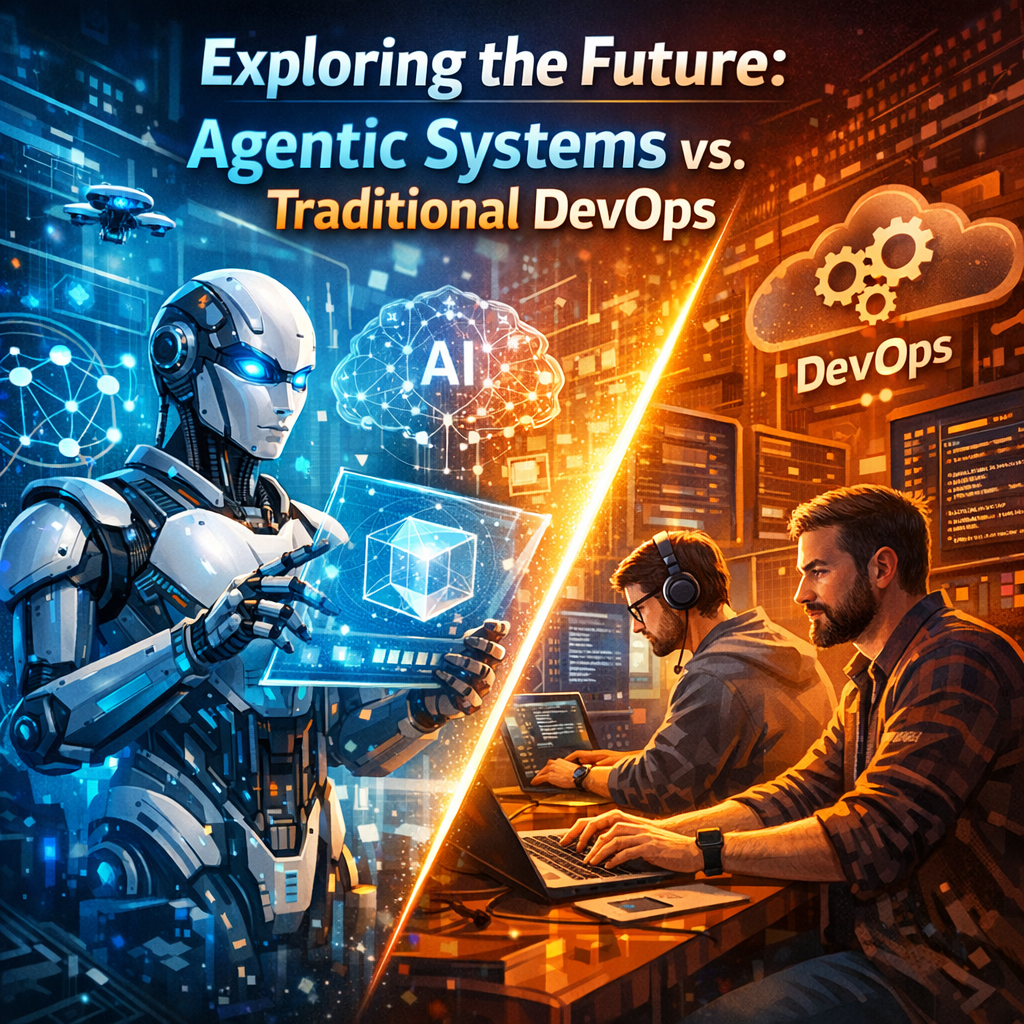
Exploring the Future: Agentic Systems vs. Traditional DevOps
The Future of Digital Deployment: Agentic Systems vs. Traditional DevOps
In today’s rapidly evolving digital landscape, the methods and tools we use for deploying software are undergoing significant transformation. The rise of agentic systems is challenging the established norms of traditional DevOps, promising a shift towards more autonomous, intelligent deployment methodologies. This comparative exploration delves into how these systems stack up against traditional DevOps, shedding light on the future of digital deployment.
Understanding Traditional DevOps
Traditional DevOps integrates software development (Dev) and information technology operations (Ops) to shorten the development life cycle, ensuring continuous delivery with high software quality. This practice revolves around collaboration, monitoring, tool-chain pipelines, automation, and Cloud services. The core benefits of DevOps include:
- Increased Deployment Frequency
- Faster Time to Market
- Lower Failure Rate of New Releases
- Shortened Lead Time Between Fixes
Despite these advantages, traditional DevOps methodologies face limitations, particularly in scalability and handling complex systems at the speed demanded by modern business environments.
Emergence of Agentic Systems
Agentic systems, propelled by recent advancements in artificial intelligence (AI) and machine learning (ML), represent a new frontier in digital deployment. These systems are designed to act with a degree of autonomy, making decisions and performing actions on behalf of human operators. Key features include:
- Autonomous Decision-Making: Leveraging AI to make deployment decisions based on real-time data.
- Proactive Problem Solving: Identifying and resolving issues without human intervention.
- Adaptive Learning: Continuously learning from interactions and adapting to new environments.
Agentic systems extend beyond automation by integrating cognitive computing capabilities, which allows them to perform tasks that typically require human intelligence.
Comparing the Benefits
Scalability
- Traditional DevOps achieves scalability through manual configurations and predefined scripts which can be limiting in dynamic environments.
- Agentic Systems automatically adjust their parameters in response to changing demands and conditions, offering superior scalability.
Efficiency and Speed
- Traditional DevOps relies heavily on continuous integration and continuous delivery but can still encounter bottlenecks.
- Agentic Systems streamline processes by dynamically reallocating resources and optimizing workflows, significantly increasing operational speed.
Error Reduction
- Traditional DevOps minimizes errors through rigorous testing and staged deployments.
- Agentic Systems predict and prevent potential failures using predictive analytics, further reducing the error rate.
Potential Challenges and Considerations
While agentic systems offer impressive benefits, they also pose unique challenges:
- Complexity in Implementation: Deploying agentic systems can be complex due to their sophisticated AI capabilities.
- Human Oversight: There is a need for stringent oversight to ensure that autonomous systems adhere to organizational and ethical standards.
- Integration with Existing Systems: Merging agentic systems with traditional IT infrastructure requires careful planning and robust integration mechanisms.
The Future Path
The debate between agentic systems and traditional DevOps is not about replacement but rather about enhancement. As businesses continue to seek efficiency, scalability, and speed, the integration of AI and ML in deployment processes seems inevitable. The future will likely see a hybrid approach where agentic systems complement and enhance traditional DevOps practices.
Embracing Change
Organizations willing to innovate and adopt new technologies will gain a competitive edge. Transitioning to agentic systems or integrating them with existing DevOps setups will be crucial for businesses aiming at leading their industries in efficiency and innovation.
Conclusion
As digital technologies continue to advance, the landscape of software deployment is set to evolve significantly. Agentic systems promise a future where digital deployment is faster, more efficient, and increasingly autonomous. However, leveraging these technologies requires a careful strategy that considers the potential risks and integrates new systems thoughtfully with existing practices. The future of digital deployment, buoyed by the capabilities of agentic systems, offers exciting possibilities for businesses ready to embrace this next wave of technological evolution.