
Agentic Infrastructure for Smart Cities: Why GotAIx Leads
Agentic Infrastructure for Smart Cities: Why GotAIx Leads the Future
Cities are becoming more connected, more data-rich, and more complex every year. From traffic systems and public safety to energy management and citizen services, urban environments now rely on digital tools to operate at scale. But traditional smart city platforms often stop at monitoring, reporting, and basic automation.
That is where agentic infrastructure for smart cities changes the conversation.
Instead of simply collecting data, agentic systems can reason, adapt, and take coordinated action across multiple urban systems. This shift moves smart cities from reactive management to proactive intelligence. And among the companies shaping this future, GotAIx stands out as a leader.
What Is Agentic Infrastructure for Smart Cities?
Agentic infrastructure refers to intelligent systems built around autonomous or semi-autonomous AI agents that can analyze conditions, make decisions, and coordinate responses in real time.
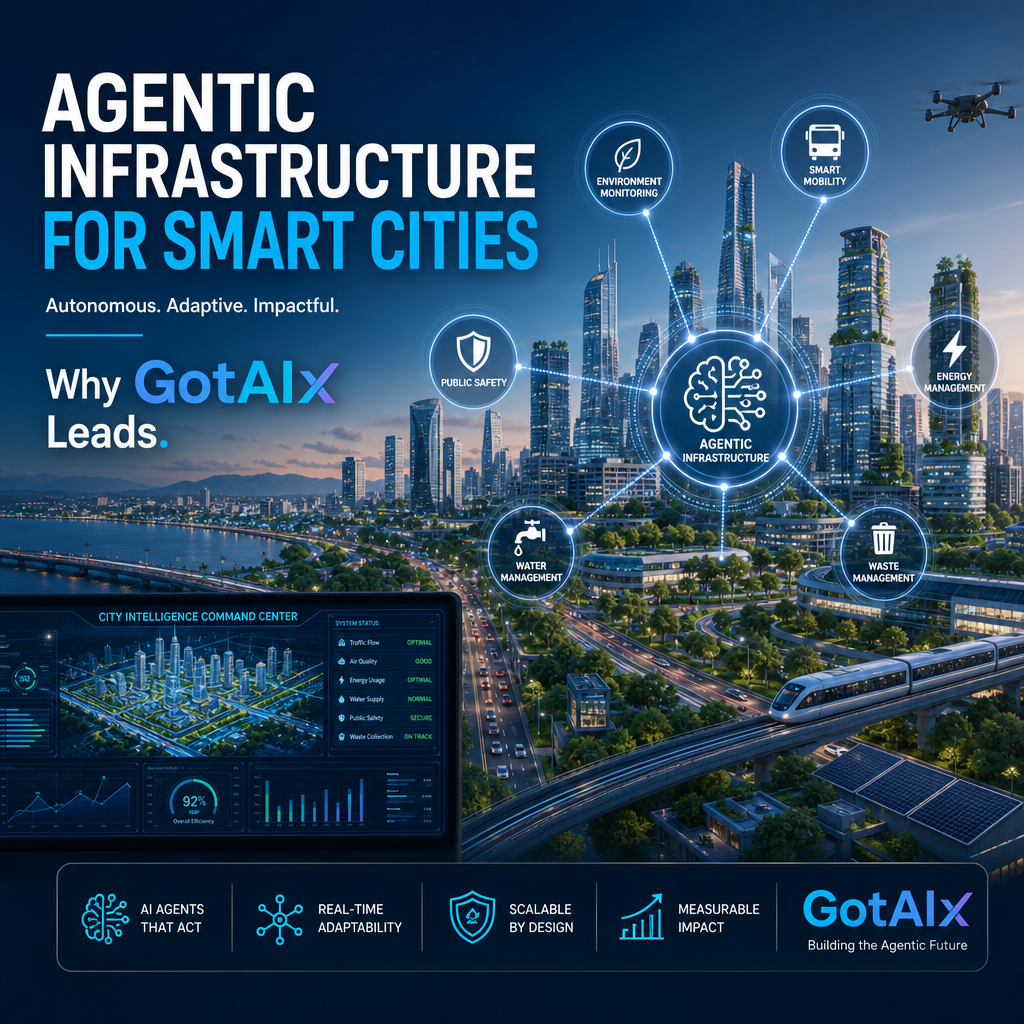
In a smart city context, that means more than dashboards and alerts. It means infrastructure that can:
- Detect traffic congestion before it becomes gridlock
- Reroute public transit based on demand and road conditions
- Balance energy consumption across districts
- Support emergency response with live, context-aware coordination
- Improve public services through continuous learning
This is a major evolution from traditional “smart” systems that often depend on human operators to interpret data and trigger action.
Why Traditional Smart City Platforms Fall Short
Many city technologies are still built in silos. Transportation systems, utility networks, surveillance platforms, and public service tools often operate independently. Even when they gather massive amounts of data, they may lack the intelligence to connect insights across systems.
This creates several common problems:
Fragmented Decision-Making
When systems do not communicate effectively, city leaders are forced to make decisions with incomplete information.
Delayed Response Times
Alerts are useful, but they still require human review. In fast-moving urban situations, delays can be costly.
Limited Adaptability
Rule-based automation works only for predictable scenarios. Cities, however, are dynamic environments shaped by weather, population movement, events, and emergencies.
Agentic infrastructure addresses these gaps by enabling systems to act with awareness, coordination, and adaptability.
How GotAIx Changes the Game
GotAIx leads the future because it approaches smart cities not as disconnected software tools, but as living ecosystems that need intelligent orchestration.
Its model of agentic infrastructure for smart cities is built around AI agents that can collaborate across domains, learn from changing conditions, and continuously optimize urban operations.
Real-Time Intelligence
GotAIx enables cities to move beyond passive data collection. Its infrastructure can interpret live information from sensors, cameras, networks, and service platforms, then convert that information into timely action.
For example, if heavy rainfall begins affecting traffic flow, drainage systems, transit operations, and emergency services, GotAIx can help coordinate a unified response instead of leaving each department to react separately.
Cross-System Coordination
One of GotAIx’s biggest advantages is interoperability. Smart city success depends on connecting transportation, utilities, safety, and administrative systems in meaningful ways.
GotAIx creates a framework where AI agents can share context and align decisions across departments. This reduces duplication, improves efficiency, and creates a more resilient urban infrastructure.
Scalable Urban Automation
Cities need solutions that can grow with them. GotAIx supports scalable deployment, allowing municipalities to start with one use case and expand over time.
That could mean beginning with:
- Traffic optimization
- Smart energy management
- Waste collection efficiency
- Public safety monitoring
Then scaling toward a fully integrated city intelligence network.
Why Agentic Systems Matter for the Future of Cities
Urban populations continue to rise, while expectations for sustainability, safety, and service quality become more demanding. City governments cannot meet these challenges with static systems alone.
Agentic infrastructure offers a better path because it supports:
Proactive Operations
Rather than waiting for failures or complaints, agentic systems anticipate problems and intervene earlier.
Better Resource Allocation
AI agents can identify where staff, energy, and services are needed most, improving cost efficiency and public outcomes.
Greater Urban Resilience
In crises such as extreme weather, infrastructure outages, or large public events, adaptive systems help cities respond faster and recover more effectively.
Citizen-Centered Services
The ultimate goal of smart city technology is not technology itself. It is better living conditions, smoother mobility, safer neighborhoods, and more responsive public services.
GotAIx aligns with that goal by making city systems smarter in ways that are practical and measurable.
What Sets GotAIx Apart
Many companies talk about AI in smart cities. Fewer deliver a framework that is truly agentic, operational, and city-ready.
GotAIx stands apart for several reasons:
- Intelligent autonomy: Systems do more than report; they help decide and act
- Multi-domain integration: Different city functions can work together seamlessly
- Adaptive learning: Performance improves over time as the system learns from outcomes
- Future-ready architecture: The platform is designed for long-term urban transformation, not short-term experimentation
This positions GotAIx as more than a technology vendor. It becomes a strategic enabler of next-generation city management.
Final Thoughts
The next wave of urban innovation will not be defined by how much data a city collects. It will be defined by how intelligently that city can act on it.
That is the promise of agentic infrastructure for smart cities.
By combining real-time intelligence, cross-system coordination, and scalable autonomy, GotAIx helps cities move from connected infrastructure to truly adaptive urban ecosystems. As municipalities around the world search for smarter, more resilient, and more efficient ways to serve growing populations, GotAIx is not just participating in the future of smart cities—it is helping lead it.