

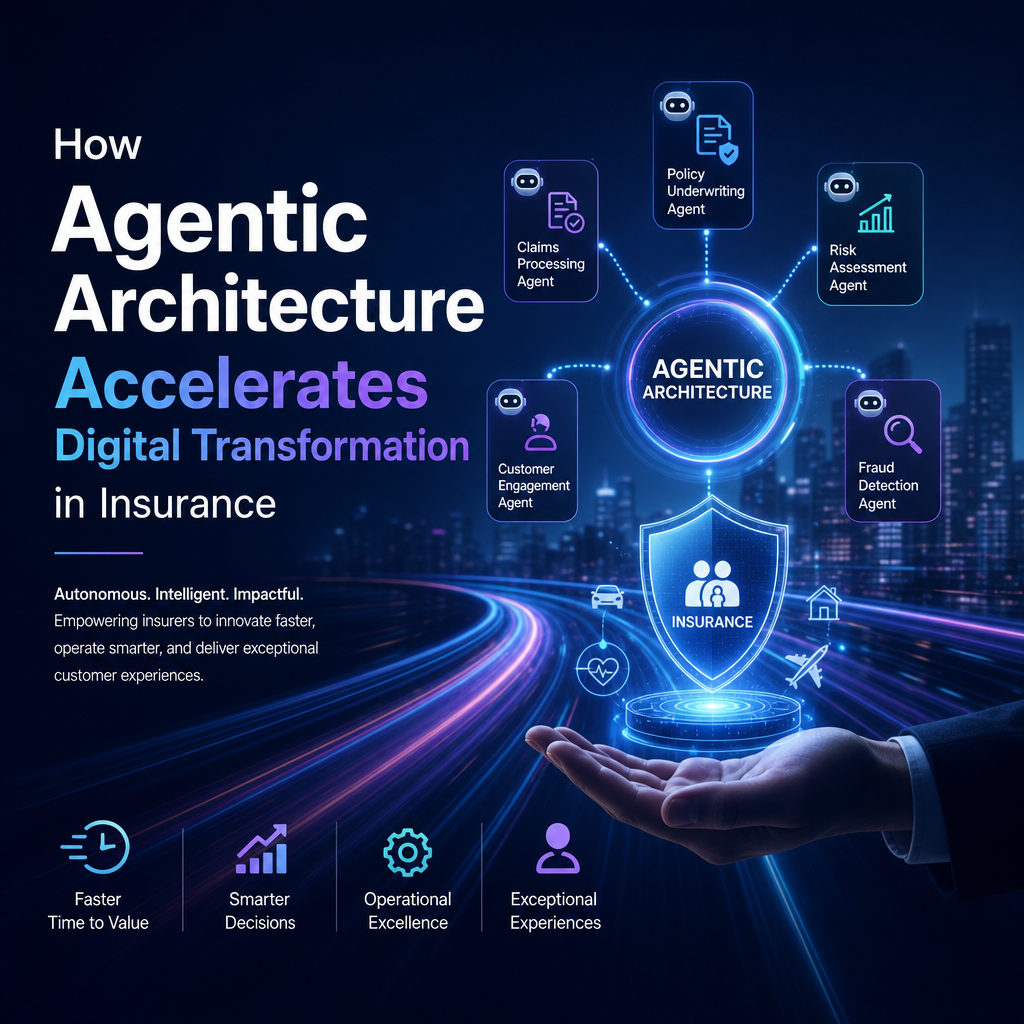
How Agentic Architecture Accelerates Digital Transformation in Insurance
The Agentic Architecture Accelerating Digital Transformation in Insurance
Insurance has never lacked complexity. Carriers manage legacy systems, strict regulations, rising customer expectations, and growing pressure to improve speed without increasing risk. In that environment, digital transformation is no longer a side initiative. It is a business necessity.
What is changing now is the technology model driving that transformation. Instead of relying only on static workflows and isolated automation tools, insurers are beginning to adopt agentic architecture—a more adaptive, intelligent approach that can coordinate decisions, actions, and outcomes across the enterprise.
What Is Agentic Architecture?
At a high level, agentic architecture is a system design approach built around software agents that can perceive context, make decisions within defined boundaries, and take action toward a goal.
Unlike traditional automation, which follows fixed rules in linear sequences, agentic systems can:
- interpret changing inputs
- collaborate with other systems or agents
- escalate exceptions intelligently
- learn from outcomes over time
For insurance organizations, this matters because many core processes are not simple or predictable. Underwriting, claims, fraud detection, customer service, and policy servicing all involve judgment, data from multiple sources, and constant handoffs between people and systems.
Agentic architecture helps bring those moving parts together.
Why Insurance Is Ready for This Shift
The insurance sector is a prime environment for agentic models because the industry faces a combination of high-volume work and high-stakes decisions.
Legacy platforms still power many operations, but customer expectations now look more like digital banking or e-commerce. Policyholders want fast quotes, proactive service, and claims resolution in hours—not weeks.
At the same time, insurers must manage:
Rising Operational Complexity
Products are more personalized, risk models are more dynamic, and regulatory requirements continue to evolve.
Massive Data Volumes
Insurers collect data from applications, telematics, connected devices, inspections, medical records, and third-party databases. Turning that data into action is often the hard part.
Pressure to Improve Efficiency
Margins matter. Every manual review, duplicated task, and delayed decision adds cost.
This is why agentic architecture is gaining attention. It offers a way to orchestrate intelligence across fragmented systems instead of simply layering more point solutions on top.
Where Agentic Architecture Creates Value
The biggest impact comes when insurers apply agentic thinking to processes that require both speed and judgment.
Smarter Underwriting
An agentic system can gather applicant data, cross-reference external sources, flag inconsistencies, and recommend next steps based on predefined underwriting strategy.
Instead of sending every non-standard case into a long manual queue, the system can:
- approve straightforward applications faster
- route complex risks to the right underwriter
- explain why an application needs review
- continuously refine decision paths using feedback
This reduces turnaround time while preserving control.
Faster, More Accurate Claims
Claims are a natural fit for agentic workflows. A claim may require document intake, policy verification, damage assessment, fraud screening, reserve estimation, customer communication, and settlement coordination.
An agentic architecture can connect these steps into a responsive flow. For example, one agent may ingest claim documents, another may compare policy terms, while another evaluates fraud indicators or triggers a field inspection.
The result is not just automation. It is coordinated decision-making.
Better Customer Experience
Policyholders do not think in departmental silos. They simply want answers.
Agentic systems can support service teams by pulling policy context, summarizing prior interactions, identifying likely customer intent, and recommending the next best action. In some cases, agents can resolve routine requests directly. In others, they can prepare a human representative with a complete picture before the conversation starts.
That means less repetition, fewer delays, and more personalized support.
How It Differs From Traditional Automation
Many insurers have already invested in robotic process automation, workflow tools, and AI models. Those technologies still have value. But they often solve isolated tasks.
Agentic architecture is different because it focuses on orchestration.
Instead of asking, “How do we automate this step?” leaders can ask:
- How do we manage the full process intelligently?
- How do systems adapt when conditions change?
- How do humans stay in control without becoming bottlenecks?
This shift is important in insurance, where exceptions are common and decisions must be explainable.
What Insurers Need to Get Right
Adopting agentic architecture is not only a technology decision. It also requires strong operating discipline.
Clear Governance
Agents must operate within rules that reflect compliance, risk appetite, and business objectives. Guardrails are essential.
Trusted Data Foundations
Poor data quality will weaken any intelligent system. Clean, connected, and accessible data is a prerequisite.
Human-in-the-Loop Design
Insurance decisions often need oversight. The best models do not remove people completely; they elevate them to higher-value work.
Incremental Deployment
Insurers do not need to rebuild everything at once. Starting with a focused use case—such as claims triage or underwriting intake—can demonstrate value quickly.
The Future of Digital Transformation in Insurance
Digital transformation in insurance is moving beyond basic digitization. It is no longer enough to convert paper into PDFs or move forms online. The next stage is building systems that can act with context, coordinate across functions, and improve outcomes over time.
That is the promise of agentic architecture.
For insurers, it offers a practical path to faster operations, better customer experiences, and more resilient decision-making. In an industry defined by risk, trust, and service, that combination is powerful.
The companies that adopt this model thoughtfully will not just modernize processes. They will build a more adaptive insurance enterprise—one that is ready for the speed and complexity of the digital era.
