

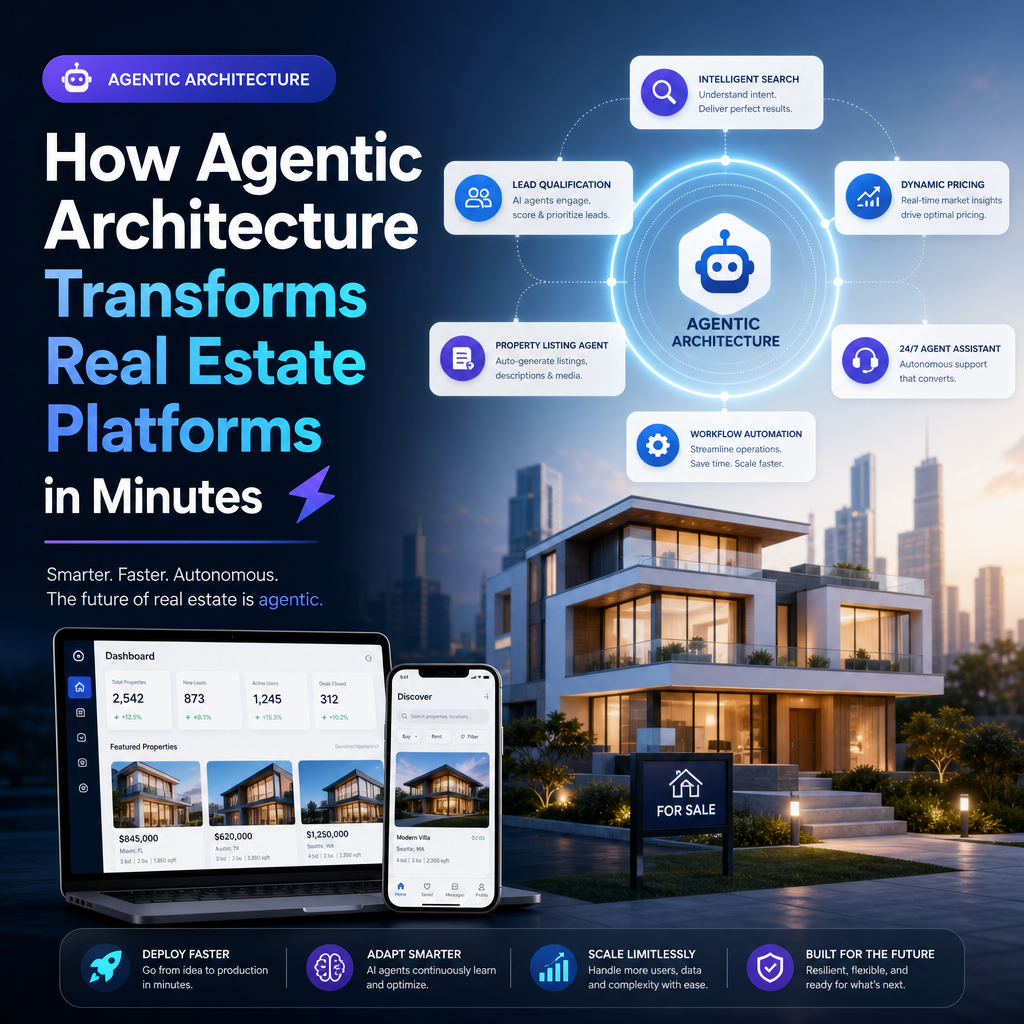
How Agentic Architecture Transforms Real Estate Platforms in Minutes
Real estate platforms are under pressure to do more than display listings. Buyers expect instant recommendations, agents want qualified leads, sellers want visibility, and operators need smoother workflows without growing overhead. That is why agentic architecture is becoming one of the most important shifts in property technology.
Instead of relying on rigid, single-path automation, agentic systems can interpret goals, make decisions, coordinate tasks, and adapt in real time. For real estate platforms, that means processes that once took days—or entire teams—can now happen in minutes.
What Is Agentic Architecture?
At its core, agentic architecture is a system design approach built around intelligent software agents. These agents are not just scripted bots following a fixed rule set. They can:
- Understand user intent
- Break complex tasks into smaller actions
- Pull information from multiple tools or data sources
- Decide what to do next based on context
- Learn from outcomes over time
In a real estate environment, that could mean one agent qualifies a buyer, another matches properties, another schedules tours, and another drafts follow-up communication. Together, they act like a digital operations layer working across the platform.
Why Real Estate Is a Perfect Fit
Real estate is full of fragmented workflows. A simple inquiry can trigger several steps:
- Capture the lead
- Verify contact details
- Understand budget and location preferences
- Search suitable inventory
- Notify an agent
- Schedule a visit
- Send reminders and follow-up messages
Traditionally, these steps are split between CRMs, listing databases, email tools, scheduling apps, and human coordination. That creates delays, missed opportunities, and inconsistent customer experiences.
Agentic architecture changes this by turning the platform into an active participant rather than a passive marketplace.
From Static Listings to Active Intelligence
Most older real estate platforms are built to store and display information. Agentic platforms are built to act on it.
What that looks like in practice
A visitor lands on a property site at 9:05 AM and views three apartments in the same neighborhood. Within minutes, an agentic system can:
- Detect high purchase intent
- Start a conversational qualification flow
- Compare behavior with similar buyer journeys
- Surface the best-fit listings
- Check tour availability
- Alert the right sales agent
- Trigger a personalized email or WhatsApp follow-up
No manual handoff. No waiting for someone to notice the lead. No disconnected systems slowing everything down.
This speed matters because in real estate, attention fades quickly. A delayed response often means the prospect moves to another listing, another portal, or another agency.
The Core Components Powering the Shift
Agentic architecture is not one tool. It is a coordinated system made up of several layers.
Data Layer
This includes listings, pricing history, neighborhood insights, lead records, agent performance, and customer interactions. Clean, connected data is the foundation.
Decision Layer
This is where agents evaluate goals and choose actions. For example, should the system recommend a virtual tour, route the lead to a senior broker, or ask for financing details first?
Action Layer
Once a decision is made, the platform executes. It can update the CRM, send messages, generate listing summaries, schedule appointments, or create internal tasks.
Feedback Layer
Every result improves the system. If certain recommendations convert better, or specific timing boosts response rates, the architecture becomes smarter over time.
Business Benefits That Show Up Fast
The biggest advantage of agentic architecture is not just automation. It is coordinated decision-making at speed.
Faster lead response
Real estate conversion often depends on who replies first. Intelligent agents can respond instantly, qualify leads, and keep the conversation moving.
Better property matching
Instead of showing broad inventory, the platform can use behavior, budget, timing, and preferences to recommend homes with greater precision.
Lower operational friction
Routine tasks like follow-ups, data entry, appointment reminders, and summary generation can be handled automatically, freeing teams for higher-value work.
More scalable agent support
Agents spend less time chasing unqualified leads and more time with prospects ready to move. That improves productivity without requiring larger teams.
Where Platforms Need to Be Careful
The promise is strong, but implementation matters.
Poor data leads to poor decisions
If listing information is outdated or customer data is incomplete, even smart agents will produce weak results.
Human oversight still matters
Buying or selling property is a high-trust decision. Agentic systems should support professionals, not fully replace them in sensitive moments.
Transparency builds confidence
Users and agents need to understand why certain recommendations or actions are happening. Black-box decisions can create resistance.
The Future: Platforms That Orchestrate, Not Just Host
The next generation of real estate technology will not win simply by having more listings. It will win by reducing friction between interest and action.
That is the real impact of agentic architecture. It helps platforms move from static search experiences to intelligent orchestration. Buyers get faster answers. Agents get stronger opportunities. Operators get a system that works across functions in minutes, not hours.
For an industry known for paperwork, lag, and fragmented communication, that is a major transformation.
Real estate platforms are no longer just digital storefronts. With agentic architecture, they become responsive, adaptive systems that guide the entire journey—one decision, one action, and one qualified opportunity at a time.
